
Guides · Barn quiltsBarn Quilt Patterns: The Names and What They Mean
A barn quilt is a quilt block painted on a big square board and hung on a barn, often 8 ft across. Most use old quilt blocks, and many of those blocks have gone by more than one name. Here are the 16 blocks in our two barn quilt packs, what each one looks like, and what's known about its name.
Where barn quilts come from
Donna Sue Groves started the first collection of barn quilts in Adams County, Ohio, in 2001. The first of the county's original 20 was dedicated on Oct. 12, 2001, and the project grew into the first barn quilt trail.
Grundy County was the first in Iowa, in the fall of 2003. Its Barn Quilt Loop runs 64 miles, past blocks from 8 x 8 ft to 12 x 12 ft. Sac County's blocks are mostly 8 ft squares painted by volunteers, with patterns picked by local quilters, most of them for a farm-related name or the family's heritage. That's worth knowing before you read too much into any block: a barn quilt often means whatever it means to the family on that farm.
Here in the Cedar Valley, Black Hawk County has two self-guided driving tours that take in 25 barn quilts.
Why one block has several names
The National Park Service notes that quilt pattern names changed as people moved. A block with a wheel in it might be Ship's Wheel on the New England coast and Prairie Star out West. Many were named for everyday objects.
In the early 1900s the quilter Carrie A. Hall sewed sample blocks and labeled each with the names she knew. Her blocks are now at the Spencer Museum of Art at the University of Kansas, and one label reads "Ohio Star, Variable Star, Lone Star, Texas Star, or Mystery Flower Garden."
You may also hear that quilts carried coded messages on the Underground Railroad. The International Quilt Museum says that story comes from one family's oral tradition, and historians haven't found evidence to back it up, so we've left it out of the meanings below. Where we couldn't find a good source for where a name came from, we say so.
The blocks in Barn Quilt Coasters
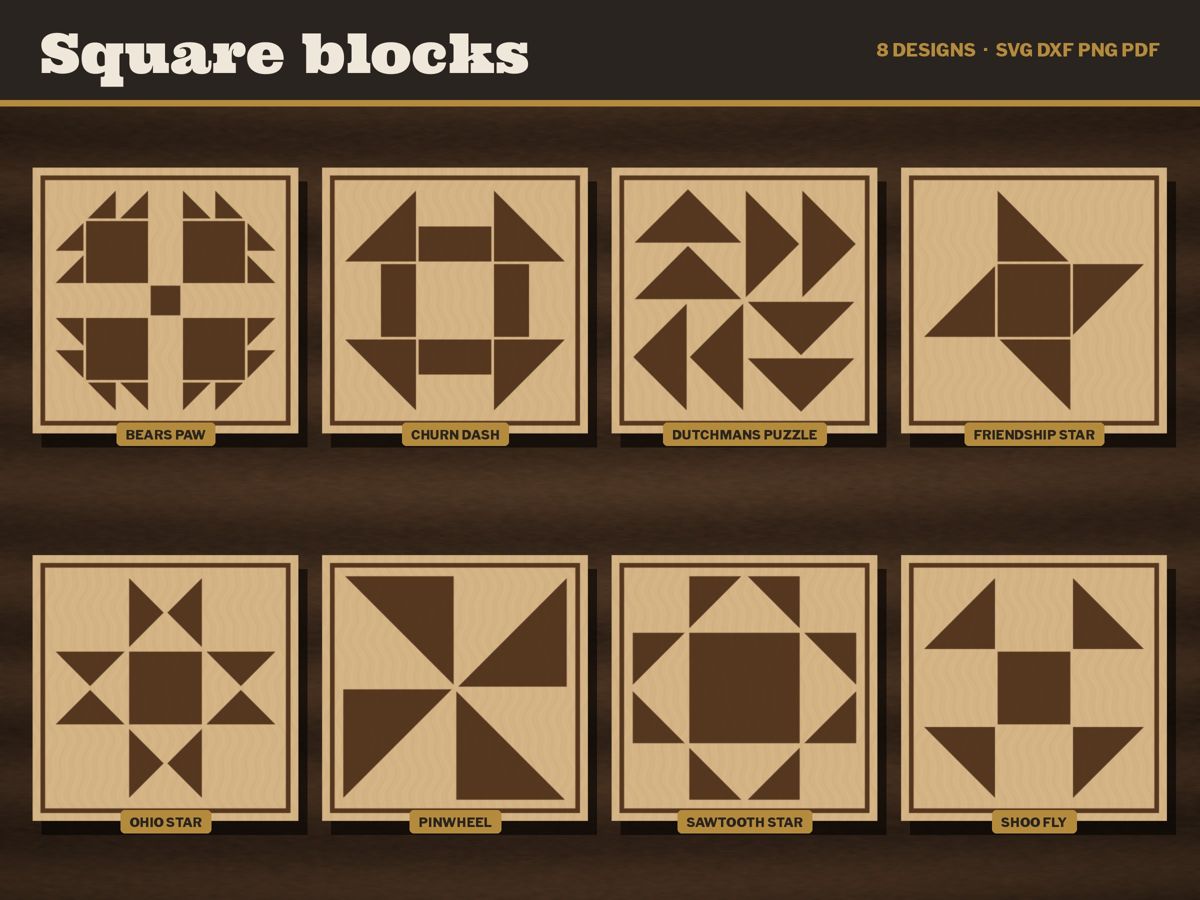
- Bear's Paw
- Four paws, each a big square with small triangle claws along two sides, set around a center cross. Fons & Porter writes that the name can depend on where you live: Duck's Foot in the Mud on Long Island, and Hand of Friendship among Quakers in Philadelphia. The International Quilt Museum has a Bear's Paw dated 1874 that is among the earliest known dated Amish quilts.
- Churn Dash
- A nine-patch with triangle corners, a bar on each side and a plain center. Hall labeled it "Churn Dash or Churn Dasher," after the plunger in a butter churn, and the Park Service lists it with Anvil, Monkey Wrench and other blocks named for everyday tools. Fons & Porter dates it to the early to mid-1800s and gives other names: Shoo Fly, Double Monkey Wrench and Puss in the Corner.
- Dutchman's Puzzle
- Eight flying-geese pieces in pairs, turned like a windmill. We couldn't find a reliable source for the name.
- Friendship Star
- Four triangles spinning around a center square, laid out on a nine-patch grid. The origin of the name isn't documented that we could find.
- Ohio Star
- A nine-patch with four pieced squares that make eight points around the center. It's the block on Hall's five-name label above. Nobody we found explains the Ohio.
- Pinwheel
- Four triangles turned so the block looks like it spins. Hall labeled hers Pinwheel, Flutter Wheel or Pin Wheels.
- Sawtooth Star
- A big center square with eight triangle points and a square in each corner. The International Quilt Museum has one from 1840 to 1860, cataloged as Sawtooth Star and also Variable Star, a name the Ohio Star shares.
- Shoo Fly
- A nine-patch with four corner triangles and a plain center and sides. Fons & Porter calls the name's origin speculation; one theory is the clover broom, or shoofly plant. It also says Hole in the Barn Door was a name popular with farmers in the mid to late 1800s. Note that Churn Dash has been called Shoo Fly too.
The blocks in Barn Quilts Vol. 2
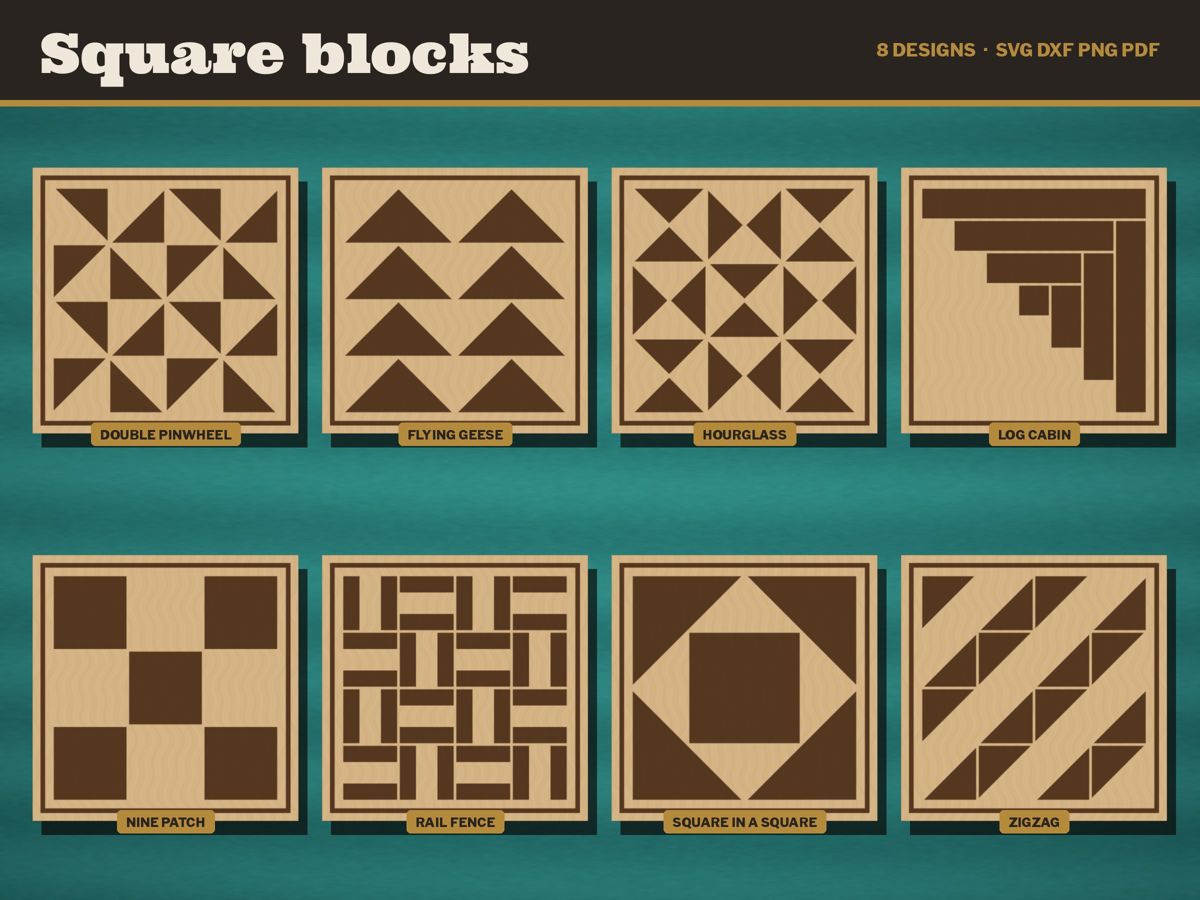
- Double Pinwheel
- A pinwheel with each blade split into two shades, so it swirls. The Park Service says it's believed to have been inspired by the windmills pioneers saw along the Oregon Trail.
- Flying Geese
- A big triangle, the goose, between two small ones, repeated in rows. The Smithsonian American Art Museum has a Flying Geese quilt from about 1840, and the International Quilt Museum has one from 1830 to 1850 cataloged as Wild Goose Chase, also called Flying Geese.
- Hourglass
- A square cut corner to corner both ways, with the opposite triangles matching. Hall's label is simply Hour Glass.
- Log Cabin
- Strips, the logs, built out around a small square, light on one side and dark on the other. The Park Service says the center was traditionally red or yellow for the hearth fire. Ours starts the logs from a corner square instead of the middle.
- Nine Patch
- Nine squares in a 3 x 3 grid. The Park Service calls out its straight seams and simple construction. Ours has dark corners and a dark center.
- Rail Fence
- Squares made of parallel strips, turned one way and then the other. The Kansas Historical Society has a quilt from 1870 to 1889 in the Roman Stripe pattern, also known as Rail Fence.
- Square in a Square
- A square turned on point inside a larger square, with triangles filling the corners. Ours adds a smaller square in the middle.
- Zigzag
- Diagonal steps that make zigzag rows across the block. Hall labeled hers Zig Zag, or Streak of Lightning.
Making barn quilt pieces on a laser
Both packs set their eight blocks up as 4 in coasters, each as a square and a round, for 16 designs per pack. They match in size and style, so the two make a set of sixteen. We left thin seams between the pieces, so a finished coaster reads like a painted barn quilt and not one solid shape. Black fill engraves and the red hairline is the cut line, and every design comes as SVG, DXF, PNG and PDF. The files are vectors, so you can scale a block up past coaster size for a wall block.
Designed in Iowa by Level B Supply Co. Made with help from an AI generator under the creative direction of the shop owner.
Sources
- Barn Quilts, Ohio Magazine.
- Curious Iowa: Why do some barns have quilt blocks on them?, Bailey Cichon, The Gazette, May 27, 2024.
- Grundy County barn quilts, Iowa Quilt Museum.
- Barn Quilts (Sac County), Iowa PBS.
- Barn Quilts of Black Hawk, Silos & Smokestacks National Heritage Area.
- Late 19th Century Log Cabin Style Quilt, National Park Service.
- The Fabric of Appalachia, Great Smoky Mountains National Park, National Park Service.
- Carrie A. Hall's quilt blocks, Spencer Museum of Art, University of Kansas: Ohio Star, Churn Dash, Pinwheel, Hour Glass, Zig Zag.
- The Quilt Code, World Quilts, International Quilt Museum.
- Bear's Paw, Churn Dash and Shoo Fly, Fons & Porter, Quilting Daily.
- Amish Quilts, Sawtooth Star quilt and Wild Goose Chase quilt, International Quilt Museum.
- Flying Geese, Smithsonian American Art Museum.
- Roman Stripe quilt, Kansas Historical Society.